Drying oven for your laboratory
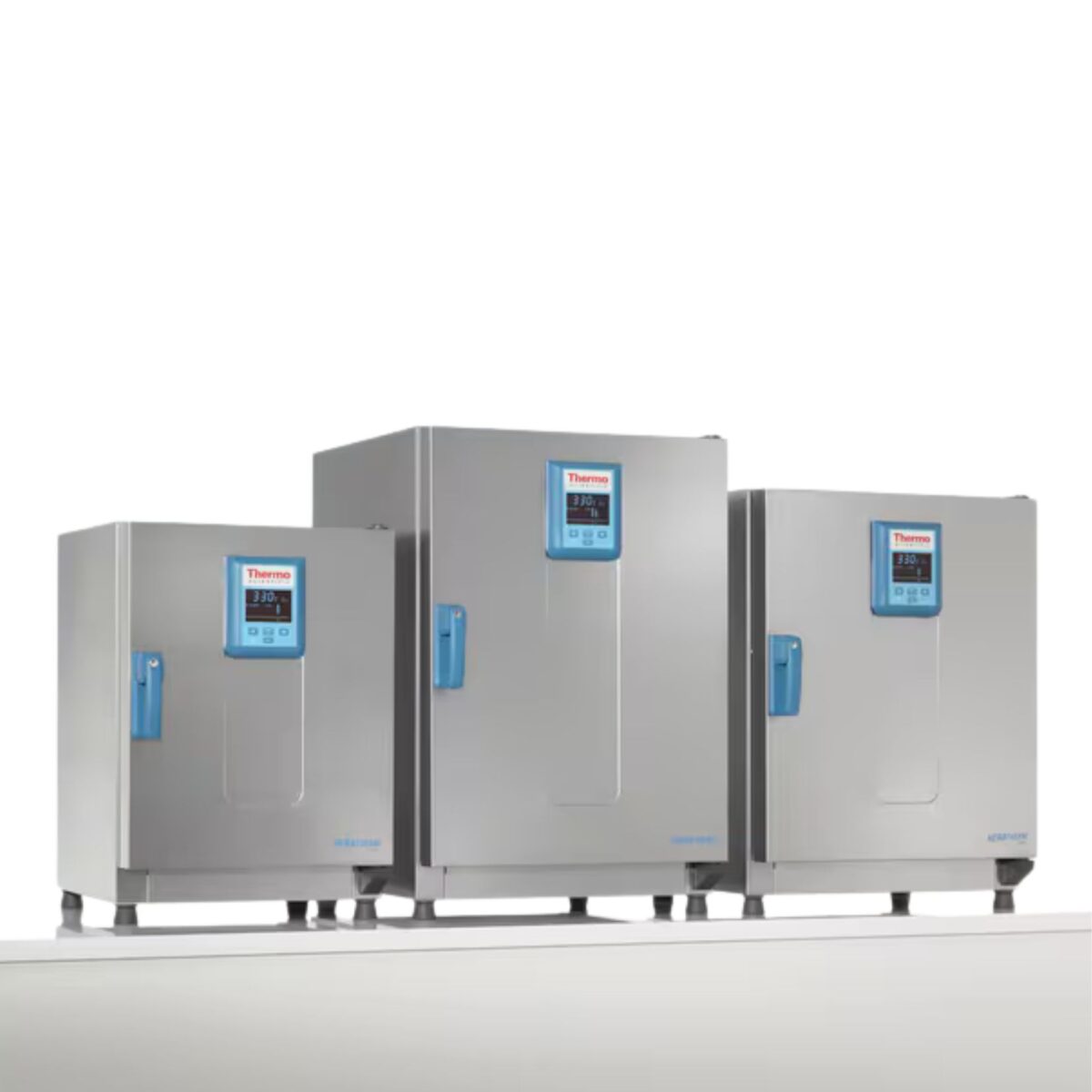
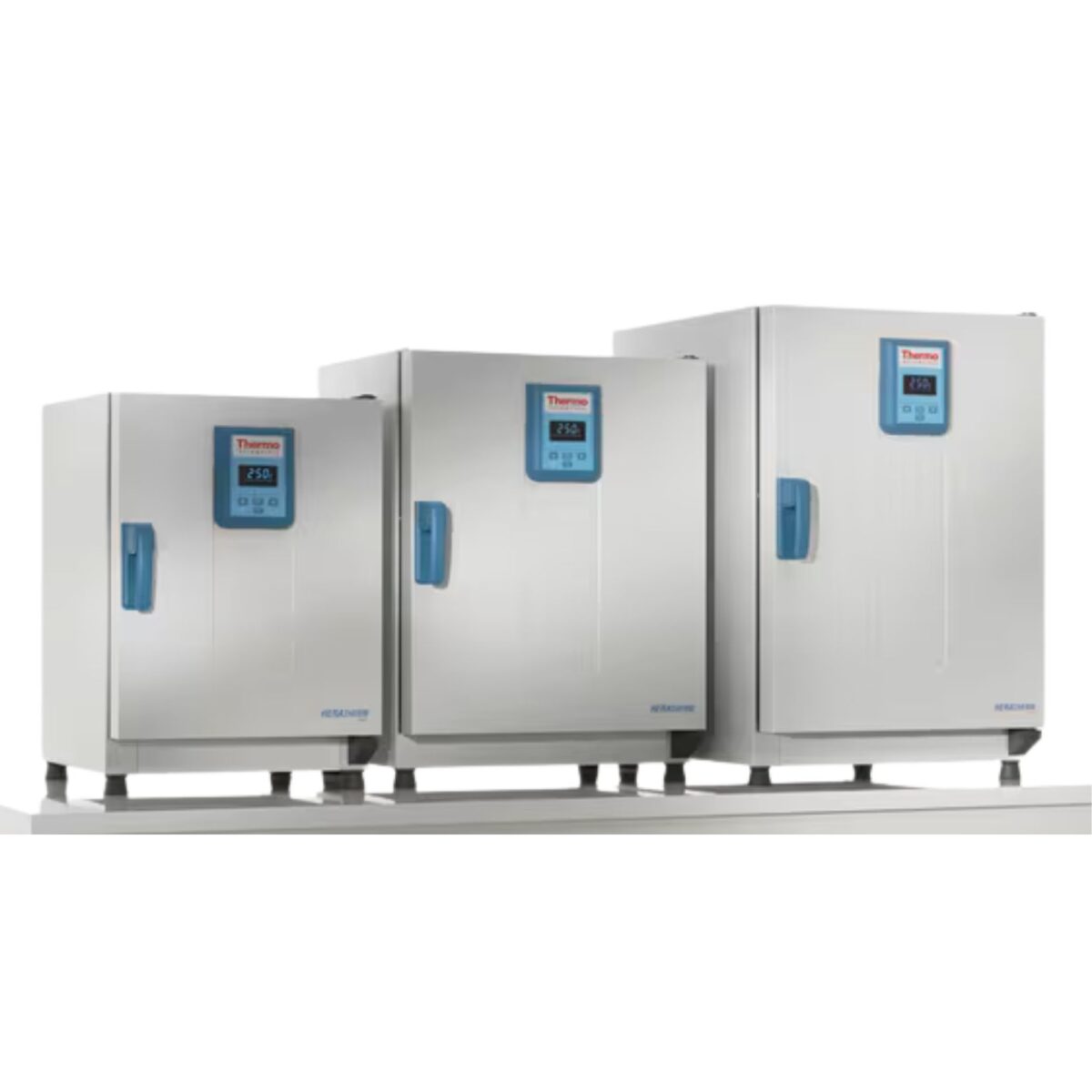
A drying oven is used for heating, drying and treating materials, samples and glassware at controlled temperatures up to 330°C. As a result, the unit provides uniform heat distribution throughout the chamber. This keeps your protocols reproducible and your results reliable. Our drying ovens from Thermo Scientific Heratherm cover the full spectrum, from compact 60 litre benchtop models to free-standing 750 litre systems.
Which types of drying oven do we supply?
Our range covers two main convection categories, each suited to specific applications and samples.
Heratherm OGS gravity convection oven: a drying oven that operates without a fan. As a result, warm air rises naturally, providing gentle, turbulence-free air movement. Suitable for delicate samples, light powders and applications where you want to avoid dehydration or air displacement. Available in capacities from 60 to 400 litres.
Heratherm OMS mechanical convection oven: a drying oven with forced air circulation through a fan. Therefore, temperature recovers faster after door openings and uniformity stays better with heavy loads. Moreover, samples dry more efficiently and evenly. Suitable for heavier applications, material testing and high-volume drying. Capacities from 60 to 750 litres.
Heratherm advanced security ovens: a configuration with extensive programmable cycles, data logging and network connection. As a result, you meet GMP and quality requirements. Suitable for certified processes and regulated environments.
Compact benchtop oven (60 to 100 litres): ideal for laboratories with limited space or for benchtop placement. Suitable for small research groups or as a secondary system.
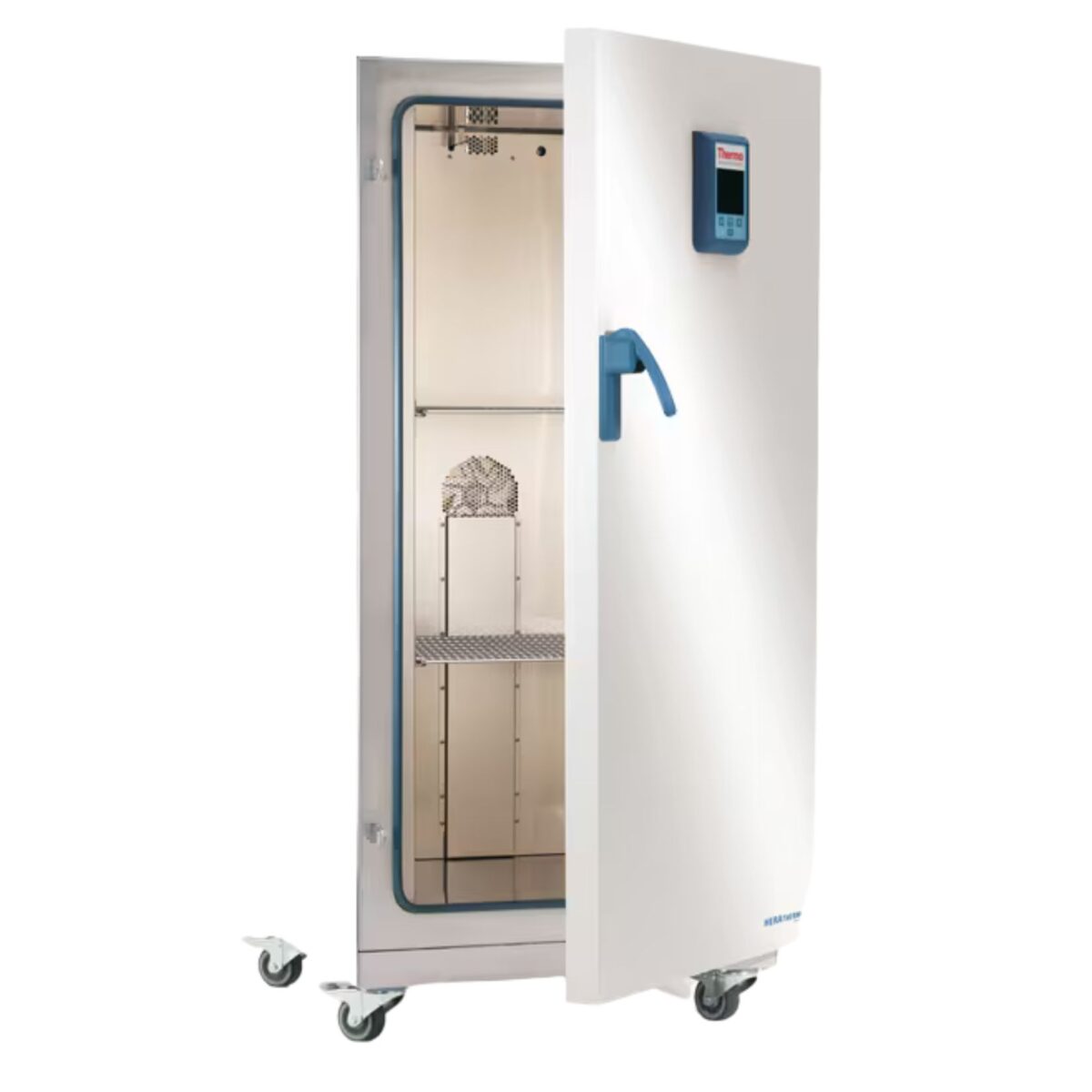
Large floor-unit drying oven (up to 750 litres): for industrial drying, high-volume material testing and large loads. With multiple shelves and uniform heat distribution, suitable for industrial scale-up.
Key technical features
Temperature range and accuracy: a Heratherm drying oven operates from 50°C to 330°C, depending on the model. Stability reaches ±0.2°C and uniformity stays within ±2.5°C at full load. Therefore, temperature-sensitive protocols remain reproducible.
Convection systems: gravity convection for gentle air movement without turbulence or dehydration risk, or mechanical (forced air) convection for fast temperature recovery and uniformity with heavy loads. The choice depends on your protocol and sample type.
Stainless steel chamber: all Heratherm models feature a smooth stainless steel chamber with rounded corners. Moreover, this construction prevents contamination build-up and simplifies cleaning.
Safety features: automatic over- and under-temperature protection, alarm systems, lockable doors and self-tests at start-up. In addition, internal sensors provide direct temperature measurement and alarm logging.
Programmable cycles and data logging: touchscreen interfaces, programmable temperature profiles and network connections support traceability for GMP and regulated environments. As a result, complex protocols and audits become easier to manage.
Which drying oven suits your application?
Drying delicate samples: choose a Heratherm OGS gravity convection oven. Natural air flow without turbulence or dehydration risk, ideal for powders and light materials.
High-volume drying and material testing: choose a Heratherm OMS mechanical convection oven with larger capacity (250L to 750L). As a result, temperature stays uniform with heavy loads.
Routine laboratory work: choose a Heratherm benchtop 100 litre with mechanical convection. Suitable for most general laboratory applications at a favourable price.
GMP and regulated environments: choose a Heratherm advanced security model with data logging, programmable cycles and network connection.
Industrial scale-up: choose a large floor-unit drying oven up to 750 litres. Suitable for material processing, production applications and high-volume drying.
Applications by sector
Pharmaceutical industry and biotech: drying of active pharmaceutical ingredients, glassware and auxiliary materials in pharmaceutical processes and R&D.
Medical diagnostics and clinical laboratories: drying of glassware, instruments and samples in medical diagnostic environments.
Food industry: drying of food samples for analysis, moisture determination and quality control within the food industry.
Agriculture and horticulture: drying of soil and crop samples, dry matter determination and analysis within the agriculture and horticulture sector.
Universities and research institutes: general laboratory applications, material testing and molecular biology research with flexible configurations.
Material research and industrial drying: curing of coatings, drying of composites, heat treatment and adhesive curing processes.
Service and maintenance on all drying ovens
Besides supplying and installing Thermo Scientific Heratherm drying ovens, we provide periodic maintenance, temperature calibration, IQ/OQ qualification and NEN 3140 electrical safety inspection. In addition, our engineers perform door seal inspection and sensor checks. Our certified service engineers work on drying ovens from all brands, including Memmert, Binder and Heraeus. For advice on the right drying oven or a maintenance contract, please contact our specialists.
Frequently asked questions about drying ovens
What is a drying oven?
A drying oven is a laboratory device that heats materials, samples and glassware at controlled temperatures, typically between 50°C and 330°C. As a result, the unit provides uniform heat distribution. A drying oven is used for drying, material testing, heating and treating various materials in laboratory and industrial environments.
What is the difference between gravity and mechanical convection?
Gravity convection works without a fan. As a result, warm air rises naturally. This keeps air movement gentle and turbulence-free, ideal for delicate samples and powders. Mechanical convection uses a fan for forced air circulation. Therefore, temperature recovers faster and uniformity stays better with heavy loads.
What is a hot air oven?
A hot air oven is another name for a mechanical convection drying oven. The fan circulates hot air throughout the chamber for uniform heat distribution. As a result, samples dry faster and more evenly than in a gravity convection oven. Hot air ovens are standard in laboratories for routine drying and heat treatment.
What temperature range does a laboratory oven offer?
A laboratory oven from Thermo Scientific Heratherm operates from 50°C to 330°C. Stability reaches ±0.2°C and uniformity ±2.5°C at full load. Moreover, programmable temperature profiles are possible for complex protocols with multiple phases.
Which capacity drying oven do I need?
For small research groups, a compact 60 to 100 litre benchtop oven suffices. Routine laboratory work requires 150 to 250 litres. For industrial scale-up and high-volume drying, choose a floor-unit from 400 to 750 litres. In addition, stackability plays a role with limited floor space.
Which drying oven brands does Poly Temp supply?
We are the official dealer of Thermo Scientific for the complete Heratherm drying oven range, including OGS gravity convection, OMS mechanical convection and advanced security models. Moreover, we provide maintenance and service on drying ovens from all other brands, including Memmert, Binder and Heraeus.
How often should a drying oven be serviced?
Annual preventive maintenance is the standard for a drying oven. This includes temperature calibration, sensor inspection, door seal check and NEN 3140 electrical inspection. For intensive use or GMP environments, semi-annual maintenance is recommended.
Can Poly Temp service a drying oven from another brand?
Yes. Our certified service engineers perform maintenance, temperature calibration and sensor inspection on drying ovens from all brands. This includes Memmert, Binder and Heraeus. Contact us for a tailored maintenance contract.
What applications use a drying oven?
A drying oven is used for sample drying, material testing, glassware drying, coating curing, drying of soil and crop samples, moisture determination of food samples and heat treatment of materials. In addition, for general laboratory applications requiring controlled heating up to 330°C.
What is the difference between a drying oven and an incubator?
A drying oven operates at high temperatures, typically 50°C to 330°C, for drying and material testing. By contrast, a bacteriological incubator operates at low to medium temperatures, typically 4°C to 105°C, for growing cells and microorganisms. Therefore, both devices are complementary and not interchangeable.