What is cryogenic storage?
Cryogenic storage covers all storage below -130°C. At this temperature, all biological processes in living cells come to a standstill. The aging process stops and cellular material remains preserved for virtually indefinite periods without loss of biological integrity. Therefore, a cryogenic freezer forms the standard for cryopreservation of cells, tissue, sperm, egg cells, embryos and other biological samples. Moreover, this technique is essential in research, clinical biobanks and pharmaceutical development. For an extensive comparison between liquid nitrogen and mechanical cryogenic cooling we refer you to our blog about cryogenic storage: liquid nitrogen or mechanical freezer.
When do you choose cryogenic storage?
For very long-term storage of stem cells, embryos, egg cells, tissue banks and sensitive cell lines, a regular ULT freezer (-80°C) is not always sufficient. A cryogenic freezer is needed when cellular activity must fully halt and samples must remain preserved for decades without degradation. This includes biobanks archiving clinical samples, fertility clinics preserving reproductive cells, and pharmaceutical companies safely storing production cell lines. For storage between -50°C and -86°C choose our ULT freezers; for storage between -10°C and -40°C our laboratory freezers.
Which types of cryogenic freezer do we supply?
Our cryogenic storage is available in two main types, depending on your storage temperature and infrastructure.
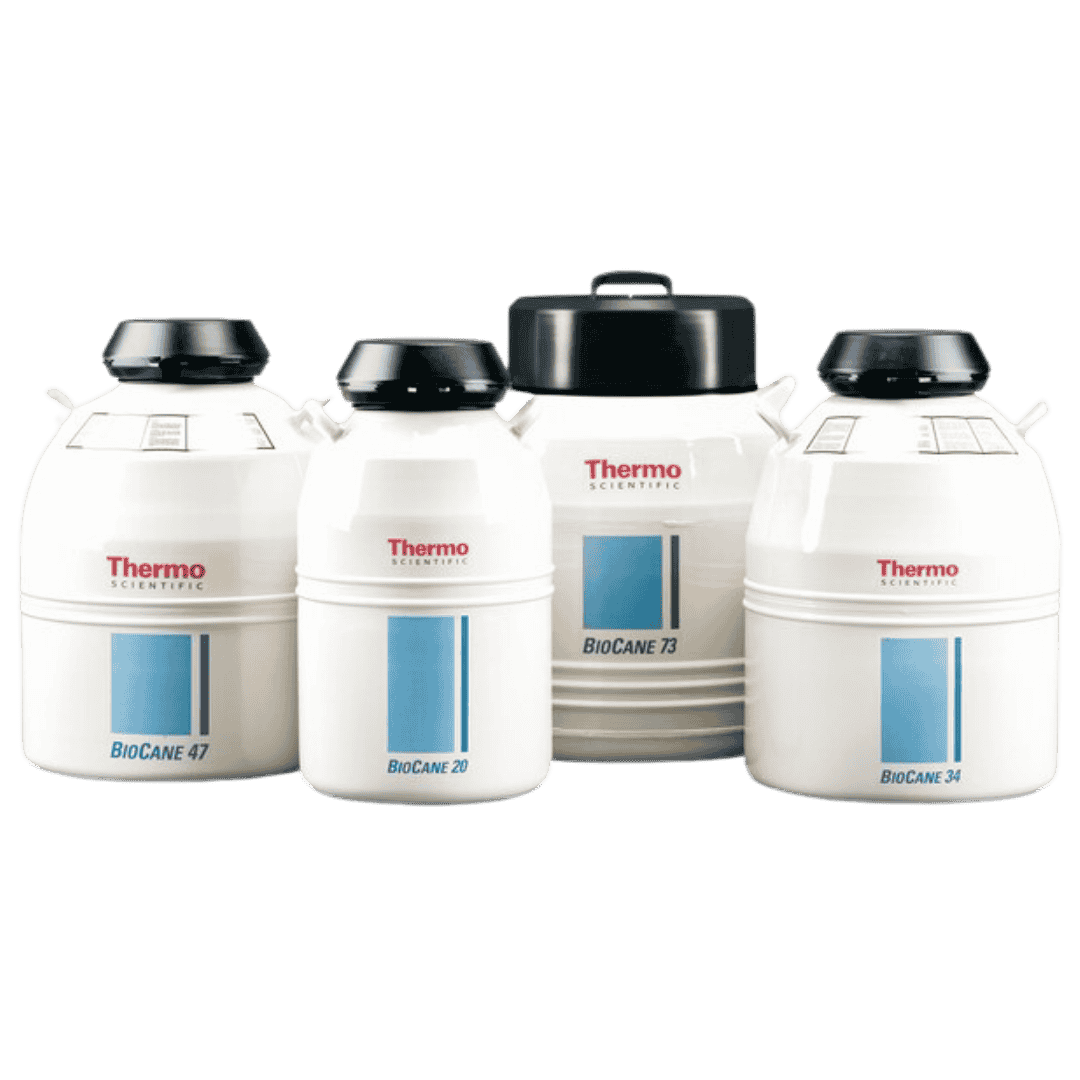
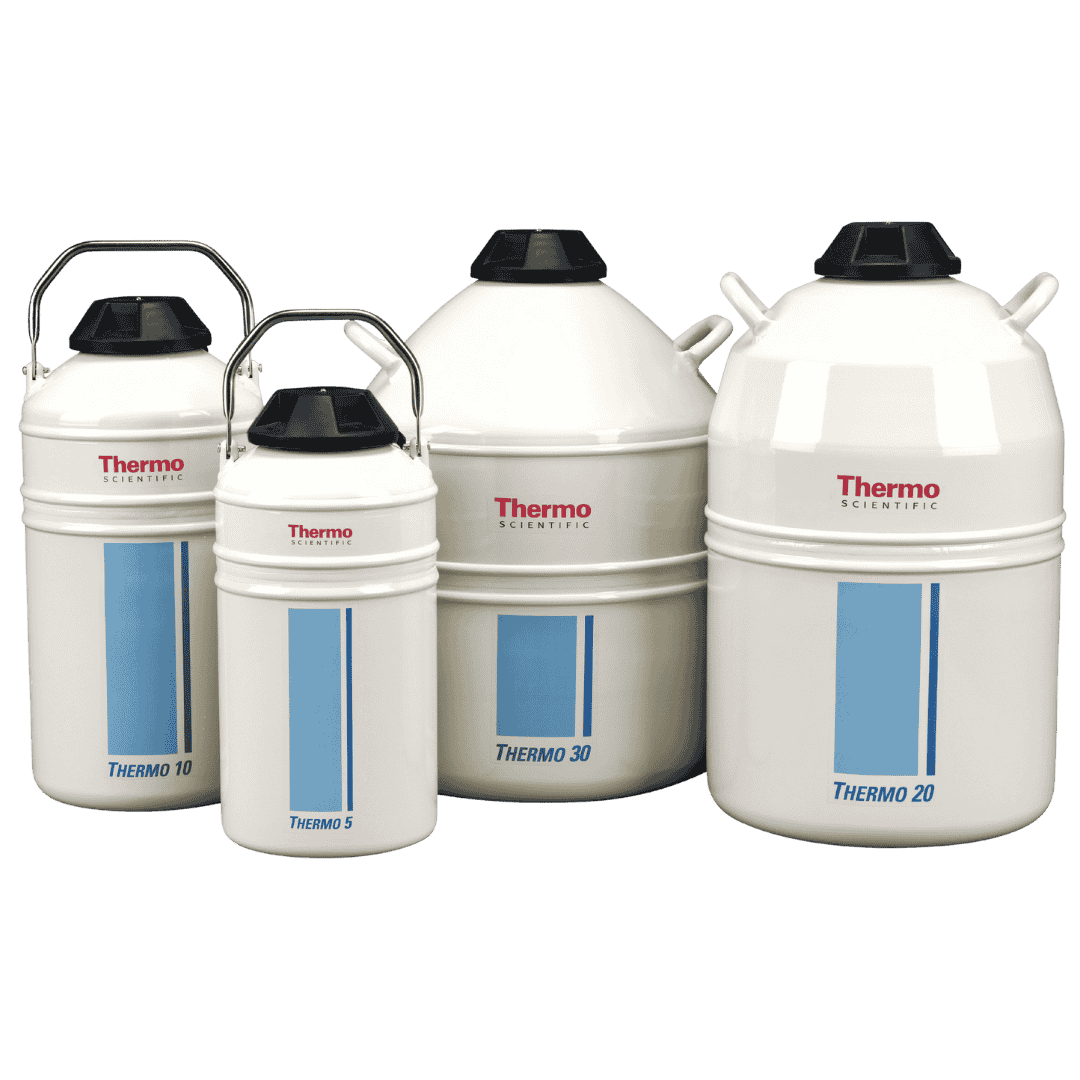
Liquid nitrogen storage (LN₂): a vacuum-insulated dewar or nitrogen tank that maintains the extremely low temperature of -196°C. You can choose between manually filled vessels and automatically filled tanks. Manually filled models have a narrower neck and lower static evaporation. By contrast, automatically filled tanks offer more user convenience and larger capacity, supplied from a central supply tank. Preservation takes place in liquid phase (-196°C) or vapour phase (-150°C to -190°C). The choice depends on sample sensitivity and required safety margin.
Mechanical cryogenic freezer (-150°C): an electrically cooled freezer that reaches -150°C uniformly through multi-stage cascade cooling without liquid nitrogen. As a result, the asphyxiation risk disappears, along with logistical dependency on LN₂ deliveries. Moreover, you use the full storage volume because no separation between liquid and vapour phase is needed. A mechanical cryogenic freezer is particularly suitable for laboratories wanting to avoid the complexity and cost of LN₂ infrastructure.
Dewars and nitrogen tanks in our range
A dewar is a vacuum-insulated vessel designed for storage and transport of liquid nitrogen or other cryogenic liquids. The double-walled construction with vacuum between the walls minimises heat transfer. As a result, only a small percentage of the contents evaporates per day. We supply dewars and nitrogen tanks in various capacities, from 5 litre tabletop dewars for small sample volumes to 1700 litre cryotanks for large biobanks. Moreover, our specialists advise on the right balance between capacity, neck opening, static evaporation and sample accessibility for your situation.
Which brands of cryogenic freezer does Poly Temp supply?
Poly Temp Scientific supplies cryogenic storage from Thermo Scientific and Labselect.
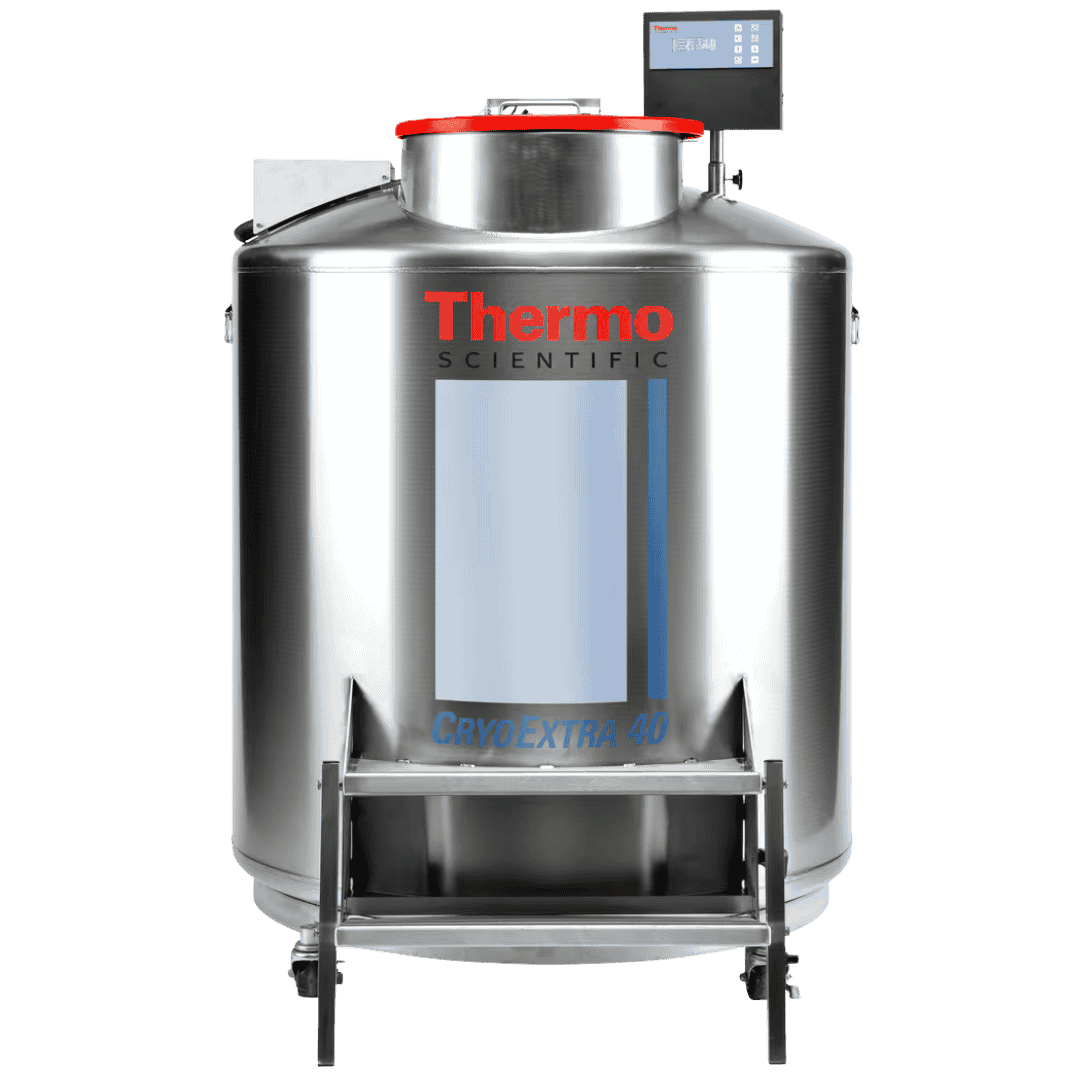
Thermo Scientific CryoExtra series: large-scale cryogenic storage vessels for biobanks and pharmaceutical storage. The CryoExtra CE8120, CE8140 and CE8194 deliver storage capacities up to 38000 cryovials in vapour phase. Each model includes automatic level control, alarms and optional Smart-Vue monitoring.
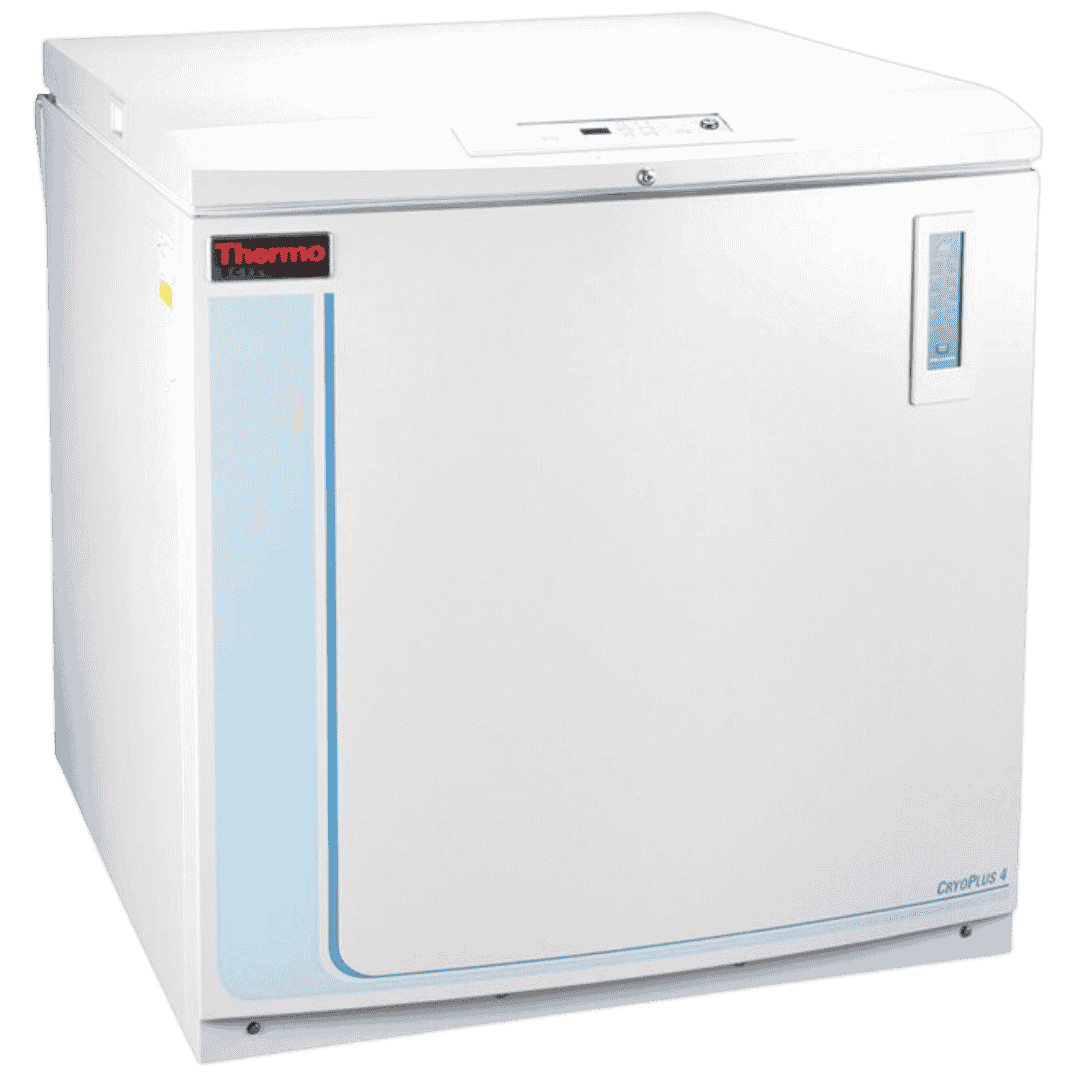
Thermo Scientific CryoPlus series: auto-fill cryogenic storage systems with microprocessor-controlled level monitoring. As a result, these models suit organisations preferring automatically filled storage over manual filling.
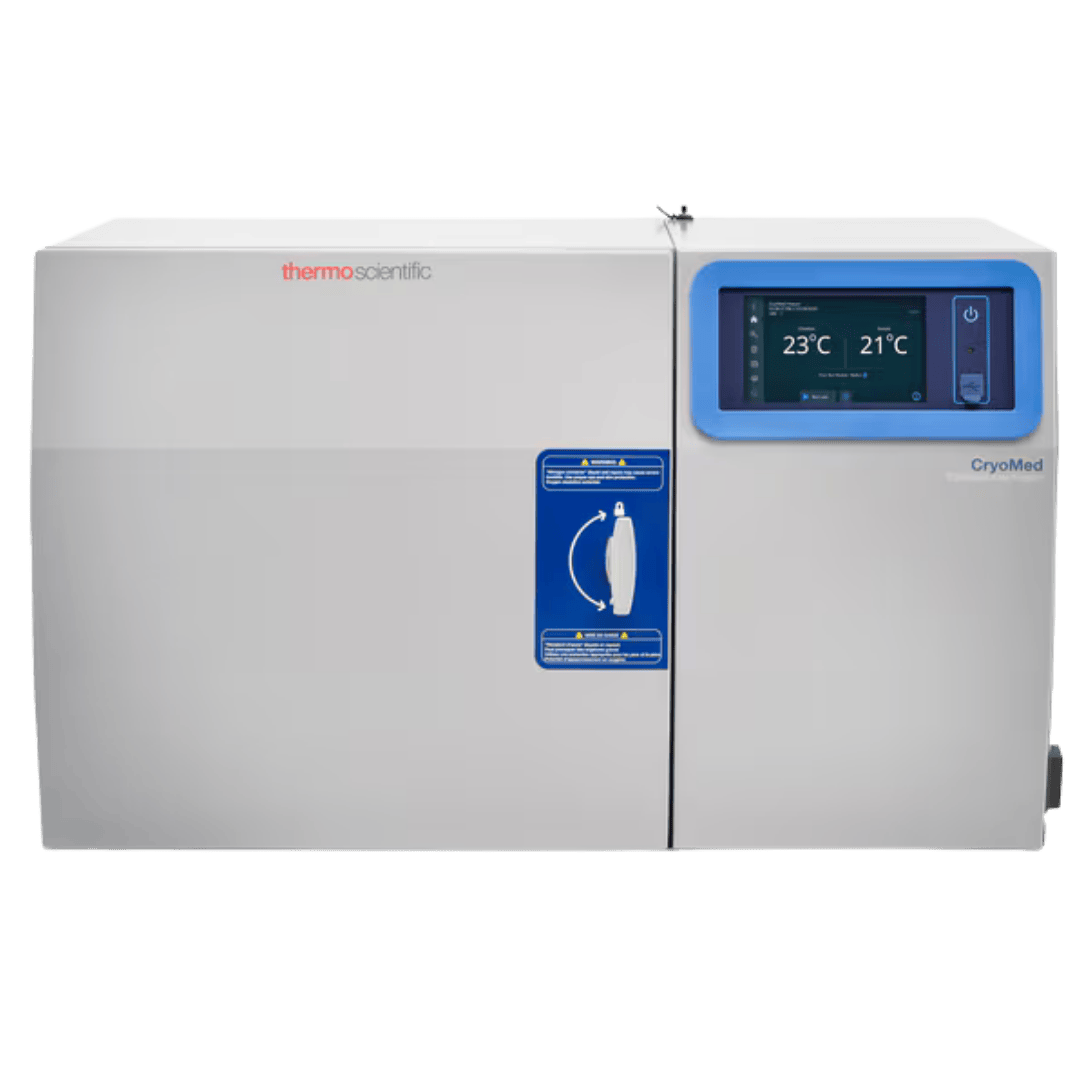
Thermo Scientific CryoMed Controlled-Rate Freezer: for controlled freezing of cells, tissue or blood components before transition to long-term cryogenic storage. Dual solenoid LN₂ injection enables precise freezing profiles for optimal cell viability after thawing.
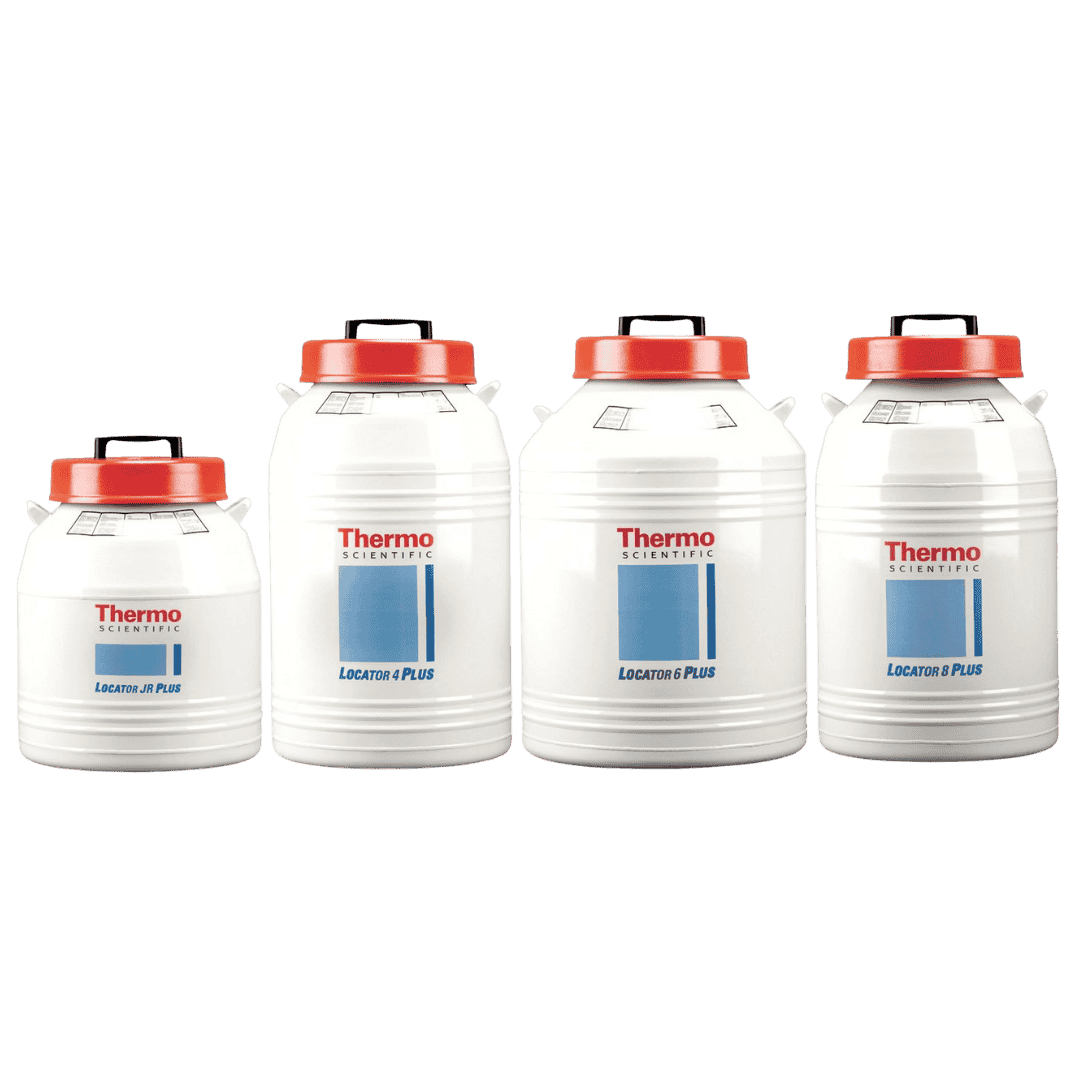
Thermo Scientific Locator series: compact dewars and nitrogen tanks for smaller storage volumes. Suitable for research groups or decentralised storage.
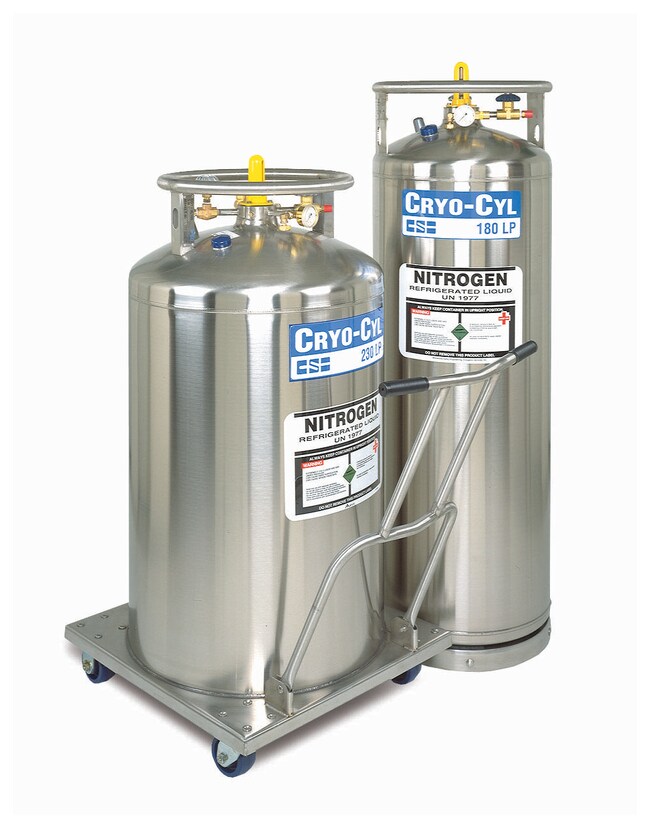
LN₂ supply and transfer systems: Thermo Scientific LN₂ Supply Tanks for central nitrogen supply and LN₂ Transfer Vessels for safe transport of liquid nitrogen within the laboratory.
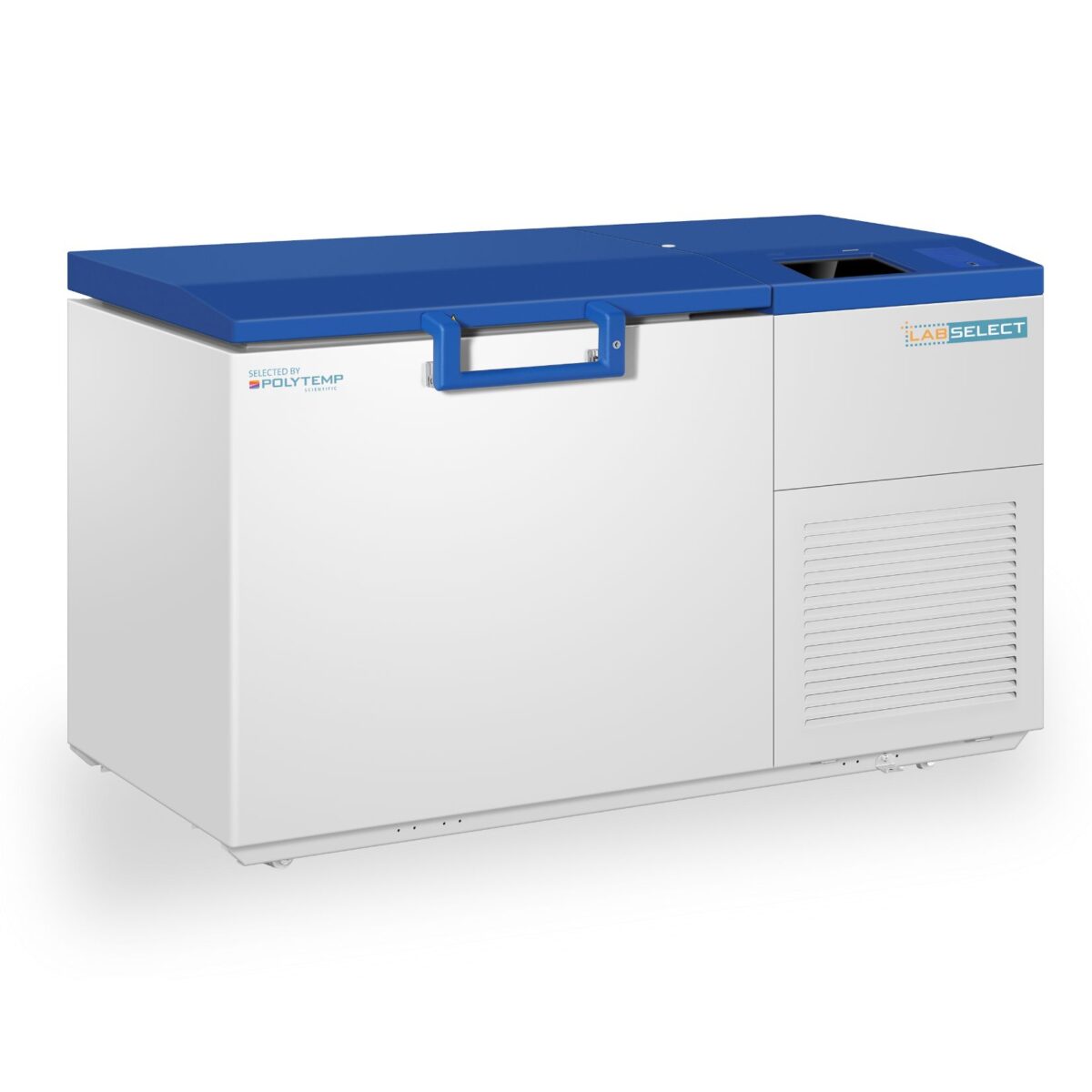
Labselect mechanical cryogenic freezer: a -150°C cryo-freezer without liquid nitrogen, with dual compressor and four-stage cascade system. The unit runs on natural HC refrigerants (GWP near 0) and standard 230V without three-phase power. As a result, this mechanical cryogenic freezer offers an easy-to-install alternative to LN₂ storage.
Liquid nitrogen versus mechanical cryogenic freezer
The choice between liquid nitrogen storage and a mechanical cryogenic freezer depends on safety, storage volume, logistics and regulations. LN₂ storage offers the lowest temperature (-196°C) and works passively during power outages. By contrast, LN₂ requires continuous nitrogen deliveries, oxygen monitoring and additional safety measures due to asphyxiation risk. A mechanical cryogenic freezer (-150°C) eliminates the asphyxiation risk and logistical dependency. Moreover, you use the full storage capacity and avoid regulations for cryogenic gas storage with larger LN₂ tanks. For a complete comparison with practical input from our director, read our blog about cryogenic storage: liquid nitrogen or mechanical freezer.
Applications by sector
Biobanks: systematic long-term storage of clinical samples, stem cells, tissue banks and biomaterial. Cryogenic storage forms the standard for samples that must remain preserved for decades.
Fertility clinics: cryopreservation of egg cells, sperm and embryos for IVF and fertility-preservation programmes.
Clinical laboratory: storage of clinical samples for medical diagnostic applications where long-term preservation is essential.
Pharmaceutical industry and biotech: storage of production cell lines, GMP-compliant preservation of biological medicines and stem cell lines for production processes.
Research and universities: cryogenic archiving of cell cultures, transgenic cell lines and valuable research material that must remain preserved for decades.
Safety and monitoring
Working with liquid nitrogen requires specific safety measures. These include adequate ventilation, oxygen monitoring in the storage room, personal protective equipment against cold burns and trained personnel. Moreover, pressure build-up in closed lines must be prevented. Our cryogenic storage systems come standard with alarms for low liquid level, temperature deviation, door-open detection and power failure. Full Smart-Vue monitoring software with audit trail is available as an option. As a result, you have continuous visibility on your liquid nitrogen supply, consumption and sample conditions. For mechanical cryogenic freezers, oxygen monitoring and specific ventilation requirements no longer apply, which significantly simplifies installation.
Service and advice for cryogenic storage
Poly Temp Scientific guides you from advice to installation and maintenance. Our certified service engineers provide periodic maintenance, calibration, validation and breakdown service for your cryogenic equipment. For dewars and LN₂ vessels we regularly check vacuum integrity and evaporation rate. For mechanical cryogenic freezers we provide compressor maintenance and cascade system validation. For advice on the right cryogenic freezer for your situation, please contact our specialists. In addition, you can request a quote directly for your chosen model. The complete overview of our cold storage equipment is available on the cold storage equipment page.
Frequently asked questions about cryogenic storage
What is cryogenic storage?
Cryogenic storage covers all storage below -130°C. At this temperature, all biological processes in living cells come to a standstill. The aging process stops and samples remain preserved for virtually indefinite periods without loss of biological integrity. Therefore, a cryogenic freezer forms the standard for cryopreservation of cells, tissue and stem cells in biobanks, fertility clinics and research laboratories.
What temperature does cryogenic storage have?
Cryogenic storage operates at temperatures below -130°C. With liquid nitrogen storage you reach -196°C in liquid phase and -150°C to -190°C in vapour phase. A mechanical cryogenic freezer maintains the full storage volume at a uniform -150°C. Both options fall well below the glass transition temperature of water (-130°C), allowing cells to remain safely in cryogenic rest.
What is a dewar?
A dewar is a vacuum-insulated vessel for storage and transport of liquid nitrogen or other cryogenic liquids. The double-walled construction with vacuum between the walls minimises heat transfer. As a result, only a small percentage of the contents evaporates per day. We supply dewars and nitrogen tanks in capacities from 5 litre tabletop models to 1700 litre cryotanks for large biobanks.
What is the difference between liquid phase and vapour phase storage?
With liquid phase storage, samples sit directly in liquid nitrogen at -196°C. By contrast, with vapour phase storage the sample hangs above the liquid level, in a temperature zone between -150°C and -190°C. Vapour phase offers lower risk of cross-contamination between samples. In addition, vapour phase reduces the risk of exploding cryovials during rapid warming. Therefore, clinical biobanks often choose vapour phase storage.
Which brands of cryogenic freezer does Poly Temp supply?
Our available brands are Thermo Scientific (CryoExtra series for biobanks, CryoPlus auto-fill systems, CryoMed Controlled-Rate Freezer for controlled freezing, Locator series for compact storage, LN₂ Supply Tanks and Transfer Vessels) and Labselect (mechanical cryogenic freezer -150°C without LN₂). Moreover, all models offer alarms, optional Smart-Vue monitoring and suitability for long-term cryopreservation.
What is a mechanical cryogenic freezer?
A mechanical cryogenic freezer is an electrically cooled freezer that reaches -150°C through multi-stage cascade cooling without liquid nitrogen. The unit uses natural refrigerants such as HC propane with low GWP. As a result, the asphyxiation risk disappears, along with logistical dependency on LN₂ deliveries and regulations around cryogenic gas storage. Moreover, you use the full storage volume because no separation between liquid and vapour phase is needed.
Which samples do you store cryogenically?
Cryogenic storage is suitable for cells, tissue samples, stem cells, sperm, egg cells, embryos, production cell lines, DNA extracts for very long-term archiving and biobank samples. This concerns material that must remain preserved for decades without degradation. For samples stored for only a few years, a ULT freezer (-80°C) often suffices.
What is cryopreservation?
Cryopreservation is the process of freezing and long-term preservation of living cells or tissue at cryogenic temperatures. The process often uses a cryoprotectant (such as DMSO or glycerol) to prevent ice crystal formation within cells. Moreover, controlled freezing at a defined cooling rate (typically 1°C per minute) is essential for optimal cell viability after thawing. For this process we supply the Thermo Scientific CryoMed Controlled-Rate Freezer with dual solenoid LN₂ injection.
How long does a cryogenic tank hold liquid nitrogen?
The hold time of liquid nitrogen in a dewar or cryogenic tank depends on capacity, neck opening, insulation and ambient temperature. A manually filled vessel with narrow neck has significantly lower static evaporation than an automatically filled system with wider neck. Our CryoExtra models reach static hold times from several weeks to over 100 days, depending on capacity and configuration.
What is the difference between cryogenic storage and a ULT freezer?
A ULT freezer operates mechanically between -50°C and -86°C and suits most biological samples including DNA, RNA and cell cultures. Cryogenic storage, by contrast, reaches -150°C to -196°C and is needed for very long-term stem cell, tissue and embryo storage where cellular activity must fully halt. Moreover, cryogenic storage is more expensive in maintenance due to LN₂ refilling, but essential for specific biobank applications.
Liquid nitrogen or mechanical cryogenic freezer, which suits my lab?
The choice depends on safety, storage volume, logistics and regulations. Liquid nitrogen offers the lowest temperature (-196°C) and passive operation during power failure, but requires continuous deliveries, oxygen monitoring and additional safety measures. A mechanical cryogenic freezer (-150°C) eliminates the asphyxiation risk and logistical dependency. Moreover, you use the full storage capacity. For a complete comparison read our blog about cryogenic storage.