40+ jaar expertise in laboratoriumapparatuur
Service & onderhoud door gecertificeerde specialisten
From orbital incubator shaker for bacterial and cell culture to vortex mixer for rapid sample preparation and gentle rocker for Western blot procedures: Poly Temp Scientific supplies and services the complete Thermo Scientific range of laboratory shakers and mixers for laboratories throughout the Netherlands.
Agitation, mixing and shaking are ubiquitous in the laboratory, but not all shaking instruments are interchangeable. The motion type, speed and amplitude together determine whether your experiment will be reproducible. The wrong choice leads to insufficient oxygen transfer in bacterial culture, foam formation in cell cultures, damage to fragile membranes during Western blots or inadequate mixing in microplate screening assays.
An orbital shaker moves the platform in a circular orbit within a single horizontal plane, creating a consistent swirl in the flask or vessel. The standard choice for bacterial culture and protein expression. An incubator shaker adds temperature control for cultivation at precise temperatures. A vortex mixer creates a rapid vortex for resuspending cell pellets and dissolving precipitates in small volumes. A rocker tilts the platform gently in a see-saw motion for delicate mixing of membranes and gels. A rotator turns tubes end-over-end for complete resuspension of sediment without foam.
An orbital shaker moves the platform in a fixed circular orbit within a single horizontal plane, generating a consistent swirl in the liquid. This ensures uniform mixing of nutrients and gases, making orbital shakers the preferred choice for bacterial culture, yeast and fungal culture, protein expression, inoculum preparation and media screening. An incubator shaker adds temperature control so that cultivation temperature and shaking speed are managed in a single instrument.
The orbit diameter (in mm) determines how much liquid is set in motion at a given RPM. Small orbit diameters of 10 to 25 mm are suited for microplates and small tubes. Larger orbits of 25 to 50 mm are the standard for Erlenmeyer flasks from 0.5 to 2 litres: the larger circular path moves significantly more liquid at the same RPM. When working at high speeds with heavy loads, always verify the maximum load capacity at the desired RPM, as this drops considerably at higher speeds.

Versatile range in three configurations: open-air models (SK2000: 25 kg; SK4000: 43 kg load capacity) for benchtop use, heated incubator shaker (SK2001/SK4001: 30 to 60°C) and refrigerated incubator shaker (SK2002/SK4002: 4 to 60°C). The refrigerated variant is suited for protein expression in E. coli at 18 to 20°C, where ambient temperature is too high for optimal protein solubility.

Innovative stackable shaker-incubator system: multiple units stacked and controlled by a single controller. Available as a heated incubator shaker (4 to 60°C) or as a CO2 incubator shaker for cell culture with CO2 regulation. Speed range 30 to 300 RPM, maximum load 20 kg. Two stacked units deliver the same throughput as two separate instruments in half the floor footprint.

Robust open-air shaker designed for use in demanding environments: cold rooms, warm rooms and conditions from 10 to 80°C. Also stackable. Speed range 15 to 500 RPM, load capacity 16 kg. Standard shakers placed in a cold room would be damaged by condensation; the MaxQ 6000 is specifically certified for these environments.

Purpose-built shaker for use inside an existing CO2 incubator. Fully resistant to the CO2-rich, humid incubator environment. Speed range 30 to 300 RPM, load capacity 6 kg. Placing a standard shaker in a CO2 incubator causes corrosion damage and voids the warranty; this is the only certified solution for suspension cell culture with agitation in a CO2 environment.
Microplate shakers are specialist instruments for mixing fluids in 96-, 384- and 1536-well microplates. They are used in ELISA, high-throughput screening, enzyme kinetics, cell incubation in microplates and PCR preparation. Two types are available: the motor-driven Digital Microplate Shaker for higher loads and the magnetically driven variant for ultra-high speeds and silent operation.

Motor-driven microplate shaker for 96-well and 384-well plates. Speed range 150 to 1200 RPM. Maximum load 4 kg at 400 RPM and 1 kg at 1200 RPM. Digital speed setting and timer. Compact design suited for benchtop use and for placement inside incubators.

Magnetically driven microplate shaker with no moving mechanical parts: silent, vibration-free and low-maintenance. The Monoshake and Teleshake reach up to 2000 RPM for 96-well and 384-well plates; the Teleshake 1536-8 achieves 4000 to 8500 RPM for 1536-well plates in HTS. Ideal for ultra-rapid homogenisation and for use in incubators where vibrations would be disruptive.
A vortex mixer is the fastest instrument for mixing samples in small volumes. An eccentric disc causes the mixing head to rotate rapidly, creating a cone-shaped vortex in the tube: cell pellets are resuspended, precipitates dissolved and reagents mixed within seconds. Vortex mixers are suited for tubes, Eppendorf tubes and, with appropriate accessories, for 1.5 ml tubes, 50 ml Falcon tubes and microplates.

Robust vortex mixer for everyday routine use. Touch mode (mixing triggered by contact with the tube) or continuous mode. Speed range 200 to 3000 RPM, load capacity 0.5 kg. Standard mixing head for tubes; a range of accessories is available for tubes from 1.5 ml to 50 ml, microplates and Eppendorf tubes.

Digital vortex mixer with precise speed setting, digital display and programmable timer function. Speed range 200 to 3000 RPM, load capacity 0.5 kg. The instrument of choice for applications where exact speed and timing must be documented, such as GMP environments, accredited laboratories and protocols with defined procedural steps.
The Thermal Mixer combines vortex-type mixing with precise temperature control in a single compact benchtop instrument. This makes it indispensable for applications where mixing and temperature must be controlled simultaneously, such as protein digestion, hybridisation steps and restriction enzyme incubations.
Mixing and heating in one compact instrument
The Thermo Scientific Thermal Mixer combines precise temperature control with continuous mixing, reducing time-consuming sequential steps (heat, then mix) to a single combined operation. The temperature range from 15°C below ambient to 100°C covers virtually all bio-analytical and biochemical incubation protocols.
The Thermal Mixer is essential for protein digestion with trypsin or Lys-C at 37°C, where enzymatic activity is highly dependent on both constant temperature and continuous agitation. The same applies to DNA ligation, restriction enzyme incubations, hybridisation steps and pre-incubation of ELISA antigens where pipetting from a separate heating vessel is not practical.
Rockers, rollers and rotators are compact benchtop instruments for applications requiring gentle agitation. They operate at lower speeds than orbital shakers and vortex mixers, and are designed for applications where sample integrity must be preserved, such as blotting, gel staining, DNA hybridisation and cell culture in tubes and bottles.
A rocker tilts the platform back and forth in a see-saw motion. Low agitation, ideal for gels, membranes and Western blots. A roller rotates tubes and bottles around their horizontal axis. Homogenises viscous fluids without foam, ideal for blood and cell culture fluids. A rotator turns tubes end-over-end for complete resuspension of sediment. The most intensive mixing of the three, without foam formation in protein solutions.

Standard see-saw rocker with digital speed setting. Platform 39 x 29 cm, load capacity 4.5 kg. Suited for gels, membranes and small vessels on the benchtop.

Larger platform rocker for washing multiple gels or larger membranes simultaneously. Load capacity 8 kg, see-saw motion. For Southern blots, Northern blots and immunoprecipitations where several membranes must be processed in parallel.

Compact rocker specifically for test tubes, Eppendorf tubes and Falcon tubes. Speed range 2 to 40 RPM, load capacity 3.4 kg. Vertical tilting motion for gentle mixing of tube contents during blood incubations and binding studies.
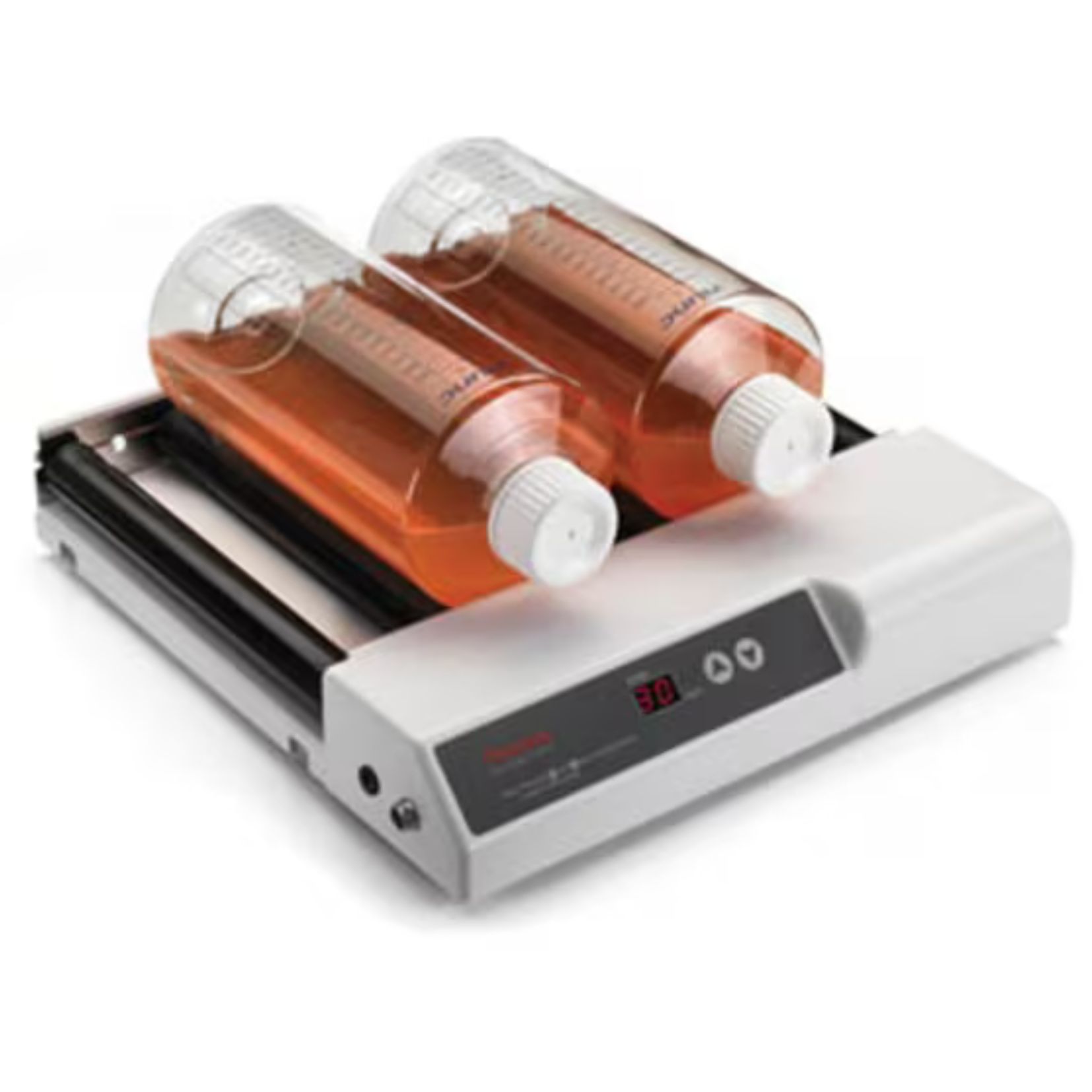
Roller bank that rotates tubes and bottles around their horizontal axis. Speed range 1 to 80 RPM, load capacity 6.5 kg, temperature range 4 to 60°C. The rolling motion homogenises viscous fluids without the foam formation that vortex mixing would cause.

Rotator with end-over-end rotation for complete resuspension of sediment. Speed range 50 to 500 RPM, compact design for multiple tubes simultaneously. The most intensive mixing in the rotator category, without foam formation in protein solutions.

Three-dimensional wave-motion rotator that combines the gentleness of a rocker with the completeness of an orbital shaker. Speed range 5 to 120 RPM, load capacity 9.8 kg. Suited for gels, membranes and hybridisations where both thoroughness and sample gentleness are required.

Compact rotator for multiple tubes simultaneously, small enough to place inside an incubator. Speed range 50 to 500 RPM, load capacity 4.5 kg. Well suited for hybridisations and precipitations requiring continuous rotation at 37°C.

Purpose-designed rotator for adherent cell culture in cylindrical roller bottles. Speed range 5 to 70 RPM, load capacity 5 kg. The slow, even rotation provides continuous renewal of the culture surface in contact with the medium, optimising cell growth in roller bottles.
An overview of the five shaking equipment categories across the most critical parameters.
| Parameter | Orbital shaker | Incubator shaker | Vortex mixer | Thermal mixer | Rocker / Roller | Rotator |
|---|---|---|---|---|---|---|
| Speed range | 15 to 525 RPM | 30 to 300 RPM | 200 to 3000 RPM | 250 to 1400 RPM | 1 to 80 RPM | 1 to 500 RPM |
| Temperature control | Optional | Roller: yes | ||||
| CO2 environment | Resistant variant | IntelliStack CO2 | ||||
| Motion type | Circular orbit | Circular orbit | Vortex swirl | Vortex + temp. | See-saw / rolling | End-over-end / wave |
| Typical volume range | 0.5 to 5 L flasks | 0.1 to 2 L flasks | 1.5 to 50 ml tubes | 0.2 to 2 ml tubes | Plates, membranes | Tubes and bottles |
| Typical application | Bacterial culture | Cell culture with temp. | Rapid sample prep | Digestion at temp. | Blotting, staining | Blood tubes, hybr. |
Not sure which type suits your protocol? Our specialists will advise you based on your application and vessel format.
Request personalised adviceThe most common purchasing error with shaking equipment is assuming that all shakers are interchangeable. They are not. An orbital shaker at high speed will damage a Western blot membrane. A rocker will provide insufficient oxygen transfer for bacterial culture. A vortex mixer applied to a protein solution will cause foam formation that denatures the protein.
Poly Temp Scientific always advises on the basis of your protocol: which motion, which speed, which vessel format, and in what environment you are working. This prevents costly experiment failures caused by the wrong instrument choice.
Orbital motion is the standard for bacterial culture and cell culture: the swirl promotes oxygen transfer and delivers reproducible growth. See-saw rocking is the choice for Western blots and gel staining: the gentle motion keeps fragile membranes intact. End-over-end rotation gives the most complete resuspension of sediment. Vortex mixing is the fastest for small volumes but too intense for cells and fragile samples.
The orbit diameter (in mm) determines how much liquid is set in motion at a given RPM. Small (10 to 25 mm) for microplates and tubes; larger (25 to 50 mm) for Erlenmeyer flasks from 0.5 to 2 litres. The maximum load capacity at your desired RPM is a second critical specification that is often checked too late. Always verify this before purchasing.
Standard shakers are not built for CO2 incubators (corrosive environment) or cold rooms (condensation, low temperature). The CO2-resistant shaker is certified for CO2 environments. The MaxQ 6000 is designed for use from 10 to 80°C in cold rooms and warm rooms. The IntelliStack has a built-in incubation function so no external environment is required.
Vortex mixers and orbital shakers at high speed cause foam formation in protein solutions, surfactant-containing media and virus suspensions, which damages the sample. A roller or rotator at low speed delivers the same homogenisation without foam. When in doubt: always choose lower agitation with a longer mixing time over high speed with a short mixing time.
Poly Temp Scientific supplies and services shaking equipment across a wide range of sectors. Recognise your situation.
Orbital shakers and incubator shakers for bacterial culture, yeast and fungal culture, protein expression and inoculum preparation. MaxQ 6000 for cold room culture at 4°C to 18°C for optimised protein solubility.
Rockers for Western blot washing and gel staining, rotators for hybridisations and precipitations, mini rotators for incubations at 37°C, vortex mixers for rapid sample preparation, and thermal mixer for protein digestion workflows.
Tube rollers for blood tubes and cell concentrates, rockers for ELISA wash protocols, microplate shakers for serological testing, and vortex mixers for sample preparation in diagnostic culture.
Incubator shakers for scale-up of bacterial culture and protein production, Thermal Mixer for enzymatic digestions in proteomics, CO2 shakers for suspension cell culture, and microplate shakers for HTS compound screening.
Cel-Gro tissue culture rotator for adherent cell culture in roller bottles, CO2-resistant shaker for suspension cell culture in CO2 incubators, and bottle/tube roller for cell culture fluids in flasks and bottles.
Orbital shakers for extractions and liquid agitation, vortex mixers for sample preparation, and bottle/tube rollers for homogenising viscous food samples without foam formation.
Answer these six questions before purchasing a shaker, mixer or rotator. Together they determine which type and model best suits your protocol and laboratory environment.
Bacterial culture and cell culture: orbital shaker. Western blot and gel staining: rocker. Rapid sample preparation in tubes: vortex mixer. Enzymatic digestion with temperature control: thermal mixer. Complete resuspension of tube contents: rotator. Blood tubes and viscous fluids without foam: roller.
Culture at precise temperatures: heated or refrigerated incubator shaker (Solaris or IntelliStack). Enzymatic reactions in small volumes: Thermal Mixer. Culture at 4°C in a cold room: MaxQ 6000. Using an existing incubator: CO2-resistant shaker or Mini Rotator that fits inside.
Microplates and tubes: microplate shaker, rocker, mini rotator or vortex. Small Erlenmeyer flasks (0.5 to 1 L): Solaris SK2000 or IntelliStack. Large flasks (2 to 5 L): Solaris SK4000 (43 kg load capacity). Always verify the maximum load capacity at the desired RPM before purchasing.
Inside a CO2 incubator: CO2-resistant shaker or IntelliStack CO2. In a cold room: MaxQ 6000. In an existing incubator at 37°C: Mini Rotator or microplate shaker. Placing a standard shaker in a CO2 incubator damages the instrument and voids the warranty.
For protein solutions, surfactant-containing media, virus suspensions and other foam-sensitive fluids: choose a roller or rotator at low speed rather than a vortex mixer or high-RPM orbital shaker. The rolling or end-over-end motion delivers the same homogenisation without generating foam.
In GMP, GLP and ISO 17025-accredited laboratories, digital instruments with precise speed settings, timer functions and alarm capability are required for demonstrably reproducible protocols. All Thermo Scientific shakers and mixers are available in digital configurations.
Laboratory shakers and mixers are subject to different standards depending on their application and sector. In accredited and pharmaceutical laboratories, demonstrable compliance during audits and inspections is a direct requirement.
IEC 61010-1 is the international safety standard for all electrical laboratory instruments. All Thermo Scientific shakers and mixers are IEC 61010-1 certified, which is required for CE marking and European market access. Always verify that the CE mark is present when purchasing shaking equipment.
In GMP environments (pharmaceutical production, QC laboratories), shakers and mixers must have documented speed control, timer settings and alarm functions. All digital Thermo Scientific shakers meet these requirements. For IQ/OQ qualification of incubator shakers, Poly Temp provides full supporting documentation.
NEN 3140 is the Dutch standard requiring periodic electrical safety inspection of all electrical equipment in the workplace, including shakers and mixers. Poly Temp carries out NEN 3140 inspections as part of the preventive maintenance contract for Thermo Scientific and all other brands.
In ISO 17025-accredited laboratories, critical instruments such as incubator shakers must be periodically calibrated for speed and temperature. Poly Temp provides speed and temperature calibration with a traceable certificate for incubator shakers and thermal mixers.
Poly Temp Scientific handles the complete inspection and calibration programme for your shaking equipment, for Thermo Scientific and all other brands. From NEN 3140 electrical inspection to speed calibration and IQ/OQ documentation.
Poly Temp Scientific provides maintenance and service for Thermo Scientific shaking equipment as well as shakers and mixers from all other brands: IKA, Heidolph, Bühler, Eppendorf, Grant, New Brunswick and more. Our certified service engineers carry out NEN 3140 electrical inspections, speed and temperature calibration, platform cleaning and all other preventive maintenance tasks.
Independent advice based on your protocol, vessel format, laboratory environment and compliance requirements
Professional placement, commissioning and instrument training, including accessory fitting and protocol demonstration
Calibration of RPM and temperature (incubator shakers) with traceable certificate, for all brands and models
NEN 3140 inspection, platform and drive unit cleaning, maximum load limiter check and motor inspection
Installation and operational qualification for incubator shakers in GMP and pharmaceutical environments
Rapid response to failures in shakers and mixers for all brands and models, minimising disruption to laboratory operations

Poly Temp Scientific is the official Thermo Scientific dealer for the complete range of laboratory shakers, mixers, rockers and rotators in the Netherlands.

Thermo Scientific offers one of the most comprehensive laboratory shaking equipment programmes in the world: from the Solaris orbital shakers for bacterial culture, through the IntelliStack incubator shakers for scalable cell culture, to the complete range of rockers, rotators and vortex mixers for molecular biology and biochemistry. In addition to Thermo Scientific, Poly Temp also provides maintenance for shaking equipment from all other brands.
Answers to the most common questions about selecting, using and maintaining laboratory shaking equipment.
An orbital shaker creates a circular motion in a single horizontal plane for powerful, uniform mixing of liquids in Erlenmeyer flasks, tubes and plates. Suited for bacterial culture (typically 100 to 300 RPM) and cell culture. A rocker tilts the platform back and forth in a gentle see-saw motion at low speed (1 to 70 RPM). Suited for gels, membranes and Western blots where the gentle wave-like motion keeps fragile structures intact. They are not interchangeable: a rocker delivers insufficient oxygen transfer for bacterial culture, and an orbital shaker damages membranes during blotting.
A vortex mixer is the right choice for rapid mixing of small volumes in test tubes and Eppendorf tubes (1.5 to 50 ml). The intensive vortex resuspends cell pellets and dissolves precipitates within seconds. An orbital shaker is the right choice for prolonged, uniform mixing of larger volumes in Erlenmeyer flasks and tubes where cells or samples must not be damaged by the intensity of vortex mixing.
An incubator shaker combines an orbital shaker with an incubator chamber that precisely regulates temperature. You need an incubator shaker when your bacterial or cell culture requires a precise temperature: typically 37°C for E. coli, 25 to 30°C for yeast, and 4 to 20°C for optimised protein expression. An open-air benchtop shaker is too dependent on ambient temperature for reproducible culture work.
The Thermo Scientific CO2-resistant shaker is an orbital shaker specifically certified for use inside a CO2 incubator. The housing and moving parts are resistant to the CO2-rich, humid incubator environment. Placing a standard shaker in a CO2 incubator causes corrosion damage to the electronics and motor, and voids the warranty. The CO2-resistant shaker is the only certified solution for suspension cell culture with agitation in a CO2 environment.
The Solaris is a versatile orbital shaker available in open-air and incubator configurations (heated and refrigerated), suited for most standard laboratory applications. The IntelliStack is a stackable shaker-incubator system with its own incubation function, designed for scalable culture work in a smaller floor footprint. The MaxQ 6000 is a robust open-air shaker for use in cold rooms, warm rooms and demanding environments from 10 to 80°C where standard shakers would be damaged.
A rocker tilts back and forth in a see-saw motion for gentle wave-like mixing of gels and membranes. A roller rotates tubes and bottles around their horizontal axis for continuous homogenisation of viscous fluids without foam, ideal for blood and cell culture fluids. A rotator turns tubes end-over-end for the most complete resuspension of sediment, without foam formation in protein solutions. The three motions are complementary and each designed for a specific sample type.
The Thermal Mixer combines vortex-type mixing (250 to 1400 RPM) with precise temperature control (15°C below ambient to 100°C) in one compact instrument. Essential for protein digestion with trypsin or Lys-C at 37°C, DNA ligations, restriction enzyme incubations and hybridisation steps where mixing and temperature must be controlled simultaneously. It replaces two separate steps (heat and then mix) with a single combined operation.
The orbit diameter (in mm) determines the liquid movement at a given RPM. For microplates and small tubes (1.5 to 50 ml), an orbit diameter of 10 to 25 mm is sufficient. For Erlenmeyer flasks from 0.5 to 2 litres, 25 to 50 mm is the standard: the larger orbital path moves significantly more liquid at the same RPM. If you work with 5-litre flasks or larger, always choose the Solaris SK4000 with high load capacity (43 kg) and confirm the orbit diameter with your supplier.
No. Placing a standard shaker inside a CO2 incubator damages the electronics through the corrosive CO2-rich, high-humidity environment, and voids the warranty. Use only the Thermo Scientific CO2-resistant shaker or IntelliStack CO2 variant. For cold rooms, the MaxQ 6000 is the certified choice for temperatures from 10 to 80°C; standard shakers have no protection against condensation at low temperatures.
Yes. Poly Temp Scientific provides maintenance and service for laboratory shaking equipment from all brands, including IKA, Heidolph, Bühler, Eppendorf, Grant and New Brunswick. The maintenance contract covers NEN 3140 electrical safety inspection, speed and temperature calibration, platform cleaning, drive unit inspection and maximum load limiter check. Contact us for a tailored maintenance contract.
From orbital incubator shaker for bacterial culture to vortex mixer for rapid sample preparation and gentle rocker for Western blot procedures: our specialists will advise you on the instrument that matches your protocol, vessel format and laboratory environment.


'%3E%3Cpath d='M0,0 v30 h60 v-30 z' fill='%23012169'/%3E%3Cpath d='M0,0 L60,30 M60,0 L0,30' stroke='%23fff' stroke-width='6'/%3E%3Cpath d='M0,0 L60,30 M60,0 L0,30' clip-path='url(%23t)' stroke='%23C8102E' stroke-width='4'/%3E%3Cpath d='M30,0 v30 M0,15 h60' stroke='%23fff' stroke-width='10'/%3E%3Cpath d='M30,0 v30 M0,15 h60' stroke='%23C8102E' stroke-width='6'/%3E%3C/g%3E%3C/svg%3E)