Laboratory centrifuge for every application
A laboratory centrifuge uses centrifugal force to separate samples by density. Heavier particles move outward; lighter components stay near the top. Our laboratory centrifuge range from Thermo Scientific covers the full spectrum, from compact mini centrifuges for quick spin-down to superspeed floor models for protein purification and bioprocessing. The right choice depends on four key parameters: maximum g-force (RCF), volume per run, rotor type and the need for cooling or CE-IVD certification.
Tabletop centrifuge for routine and diagnostics
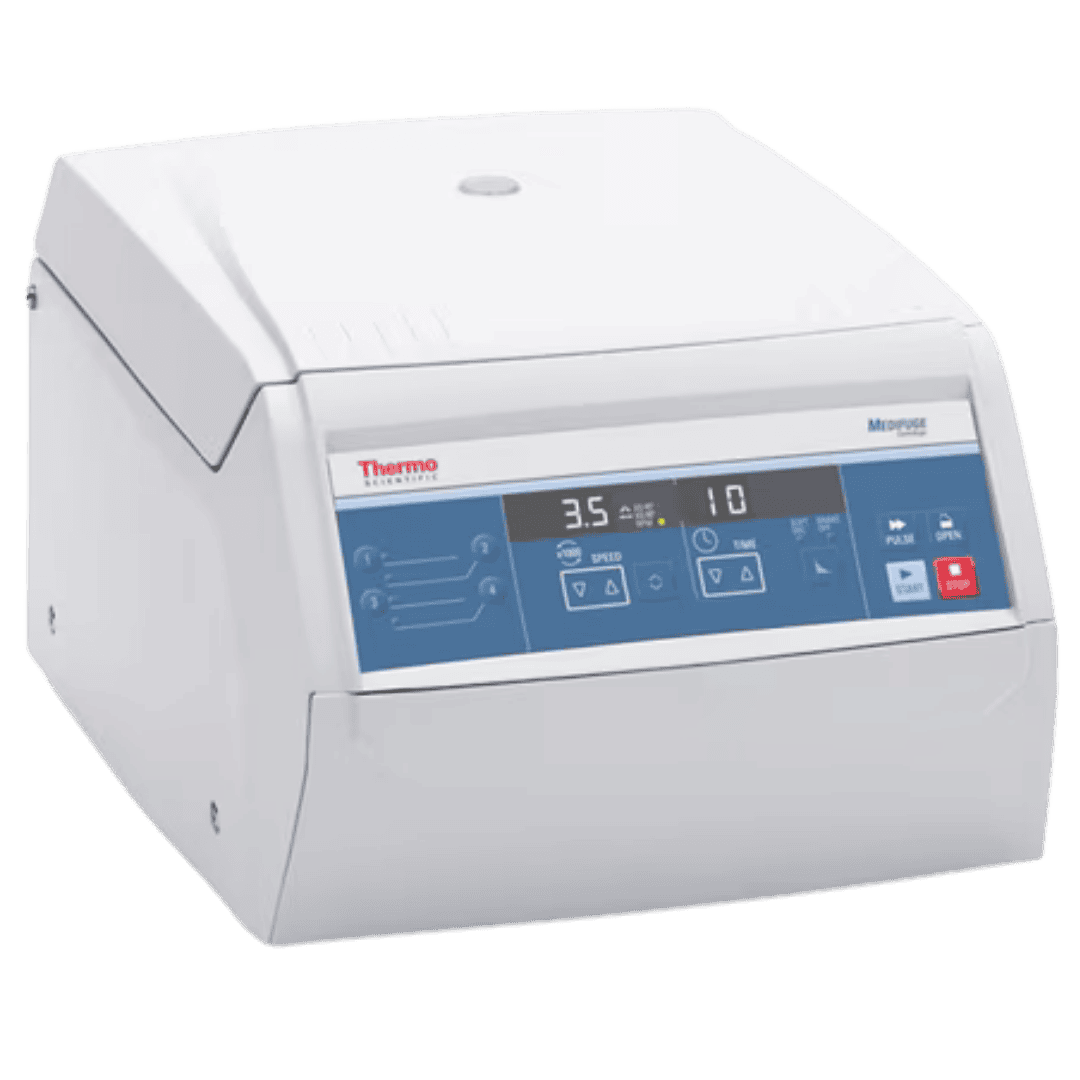
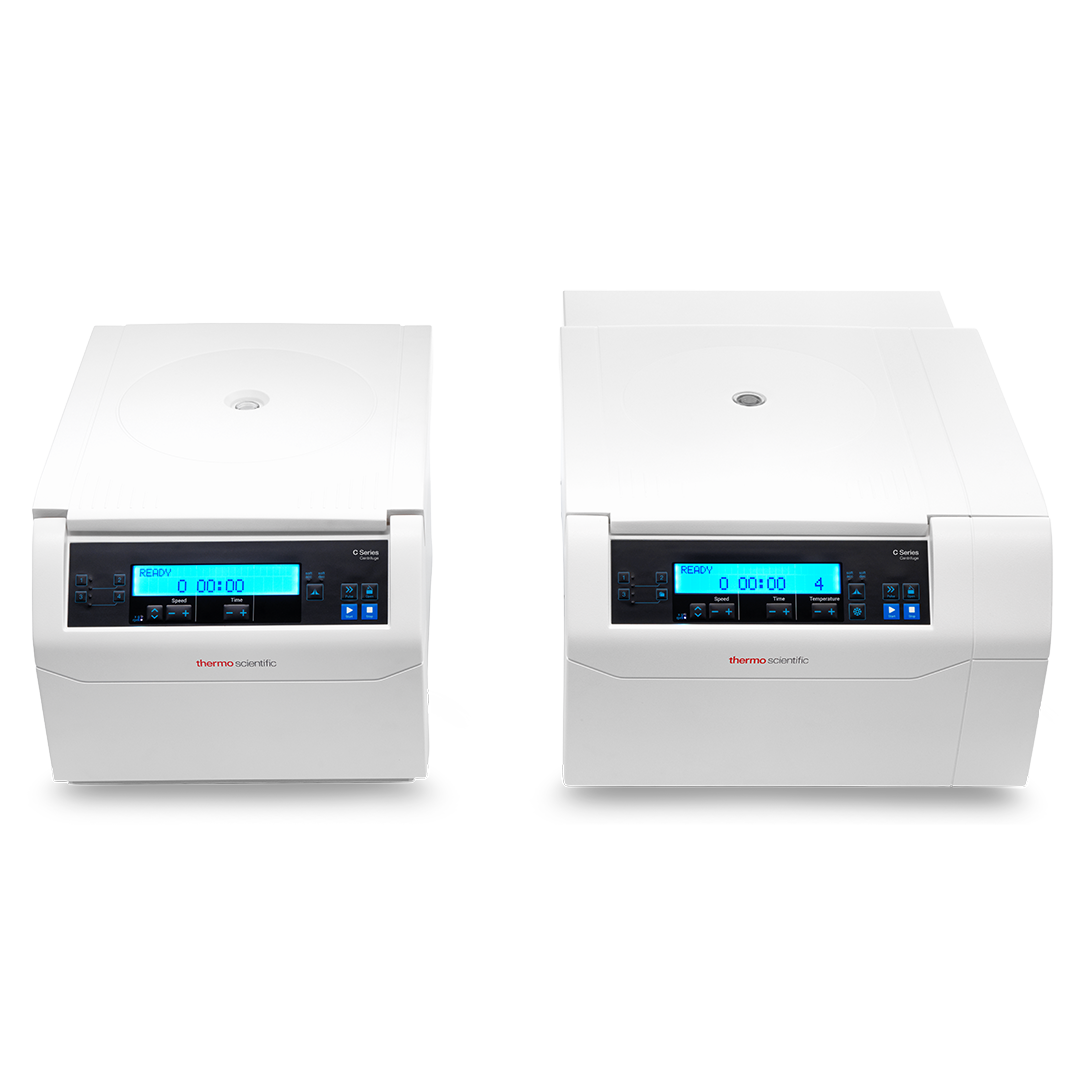
A tabletop centrifuge fits on the workbench and handles volumes from a few millilitres to 4 litres per run. Our tabletop centrifuge models include the Medifuge for routine clinical diagnostics, the C/X/S Series for high-capacity diagnostics with CE-IVD option, the Megafuge Plus for high-volume routine work and the Multifuge X Pro for research laboratories. A tabletop centrifuge fits in virtually any laboratory space without requiring extra floor area.
Microcentrifuge and mini centrifuge for molecular biology
A microcentrifuge handles small volumes, typically 1.5 and 2.0 ml tubes (Eppendorf) and PCR strips. Our MicroCL 17 and 21 microcentrifuge reaches 21,100 x g, with optional cooling for temperature-sensitive samples such as proteins and RNA. For quick spin-down applications we supply the mySPIN mini centrifuge. As a result, you easily combine reagents before starting a protocol. A microcentrifuge or mini centrifuge is essential in every molecular biology laboratory.
Which laboratory centrifuge suits your application?
The choice depends on your protocol and sample type. For routine blood separation and urine sediment, 300 to 3,000 x g is sufficient. Cell biology and molecular biology typically require 5,000 to 30,000 x g. Purification of proteins, viruses and subcellular organelles requires superspeed centrifugation above 30,000 x g.
Our available models include the mySPIN minicentrifuge (up to 9,800 x g), MicroCL microcentrifuge (up to 21,100 x g), Medifuge clinical centrifuge (up to 3,114 x g), C/X/S Series high-capacity tabletop centrifuge (up to 30,279 x g, CE-IVD option), Multifuge X Pro and Megafuge Plus high-capacity centrifuges (up to 30,279 x g), Sorvall LYNX superspeed floor centrifuge (up to 100,605 x g), Cryofuge blood bank centrifuge (CE-IVD) and the BIOS bioprocessing centrifuge (up to 12,000 x g, 16 litre capacity).
Applications by sector
Clinical laboratories and hospitals: routine diagnostics, blood separation and urine sediment in medical diagnostic environments. For diagnostic applications, CE-IVD certification is required under IVDR 2017/746.
Pharmaceutical industry and biotech: protein purification, cell separation, quality control and upstream bioprocessing for production processes and R&D.
Universities and research institutes: molecular biology, cell biology, microbiology and biochemistry research with a broad range of centrifuge types.
Blood banks and transfusion services: blood component separation with CE-IVD certified Cryofuge for plasma separation and platelet isolation.
Food industry: separation of food components, quality control and microbiological analyses within the food industry.
Agriculture and horticulture laboratory: soil analysis, plant extracts and molecular plant pathology within the agriculture and horticulture sector.
Service and maintenance on all centrifuge brands
Besides supplying and installing Thermo Scientific centrifuges, we provide periodic maintenance, NEN 3140 electrical safety inspection, RPM calibration and rotor inspection on centrifuges from all brands. This also includes Eppendorf, Beckman Coulter, Hettich and Sigma. Our certified service engineers register rotor lifespan and advise on timely replacement as a safety measure. For advice on the right laboratory centrifuge or a maintenance contract, please contact our specialists.
Frequently asked questions about laboratory centrifuges
What should I consider when choosing a laboratory centrifuge?
Before selecting a laboratory centrifuge, determine four key parameters: maximum g-force (RCF, not RPM), volume per run, rotor type (fixed-angle or swing-out) and whether cooling is required. In addition, CE-IVD certification plays a role for diagnostic applications. For a complete selection guide with sector advice, see our laboratory centrifuges page.
What is the difference between a tabletop centrifuge and a floor model?
A tabletop centrifuge fits on the workbench and suits most laboratory applications up to 4 litres per run. A floor model such as the Sorvall LYNX or BIOS offers larger capacity and higher g-forces, but requires extra floor space. In addition, noise level and energy consumption play a role during intensive use.
When do I choose a microcentrifuge?
A microcentrifuge is the right choice for small volumes, typically 1.5 and 2.0 ml tubes and PCR strips. This concerns DNA/RNA isolation, protein precipitation and cellular applications in molecular biology. For temperature-sensitive samples, choose the cooled variant (R model).
Is a cooled laboratory centrifuge necessary?
A cooled centrifuge is necessary when your samples are temperature-sensitive. Proteins, enzymes, RNA and living cells degrade with temperature rise during centrifugation. Non-cooled centrifuges are cheaper but limited in application. When in doubt, a cooled model is always the safer choice for sample integrity.
Which brands of laboratory centrifuge does Poly Temp supply?
Poly Temp Scientific is the official Thermo Scientific dealer for the complete centrifuge range in the Netherlands. In addition, we provide maintenance and service on centrifuges from all other brands, including Eppendorf, Beckman Coulter, Hettich and Sigma.
What is CE-IVD and when is it required?
CE-IVD certification is legally required under the IVDR (2017/746) for centrifuges used in diagnostic testing of patient material. The Cryofuge and C/X/S Series are available as certified IVD-MD variants. When in doubt about whether the right model is ordered, contact our specialists.
What is the difference between RPM and RCF?
RPM (revolutions per minute) describes rotor rotation speed but does not account for rotor radius. RCF (Relative Centrifugal Force, expressed as x g) is the actual force acting on your sample and is the only unit comparable between different centrifuges and rotors. Always use RCF in your protocols for reproducible results.
Can Poly Temp also service centrifuges from other brands?
Yes. We perform periodic maintenance, NEN 3140 inspection, RPM calibration and rotor inspection on centrifuges from all brands. This also includes Eppendorf, Beckman Coulter, Hettich and Sigma. Contact us for a tailored maintenance contract.
What is the difference between a fixed angle rotor and a swing-out rotor?
In a fixed angle rotor the tubes sit at a set angle and the pellet forms against the tube wall. In a swing-out rotor the buckets swing horizontal, so the pellet settles flat on the bottom. Fixed angle is faster and more compact, swing-out gives sharper separation and suits microplates.
What are the types of centrifuge rotors?
The three common types are fixed angle, swing-out (also called swinging bucket) and vertical. Fixed angle suits pelleting and high speeds, swing-out suits density gradients and microplates, and vertical rotors give the shortest path length for gradient separations.
Do centrifuge rotors expire?
Yes. Aluminium rotors fatigue under repeated loading, so manufacturers often specify a maximum number of runs or a speed derating after a set period. Keep a logbook of run hours, inspect for corrosion and pitting at every service, and replace or derate the rotor as specified.
Why does a centrifuge need to be balanced?
Imbalance creates vibration that damages the drive shaft and bearings, and in extreme cases causes rotor failure. Always load tubes in opposing pairs of equal weight rather than equal volume, and top up a counterbalance tube with water until both weigh exactly the same.